
CPD Solutions has been delivering work-based veterinary PgCert programmes since 2018. Our programmes are completed over 12 months, are practical wherever possible and are deliberately connected to the cases you are seeing and managing in your own practice. This is why each module includes a case log. This is not a collection of detailed case reports, but a concise record of representative clinical cases you have managed.
Linking your postgraduate training and learning to your own clinical experiences can be extremely rewarding, as new insights can be put into practice very quickly. The case log is an important part of that process.
What is a PgCert case log?
For our PgCerts, the case log is a concise table that records a representative selection of relevant cases you have seen and managed during your PgCert. Ideally, these will be cases managed during the learning period, although a relatively recent case from shortly before the programme may sometimes be suitable if it offers a particularly valuable opportunity for reflection.
Depending on the programme, you might record information such as:
- an anonymous case number
- the date
- signalment
- presenting problem
- relevant investigations
- diagnosis
- treatment or procedure
- outcome
An example of what it should look like is shown below:
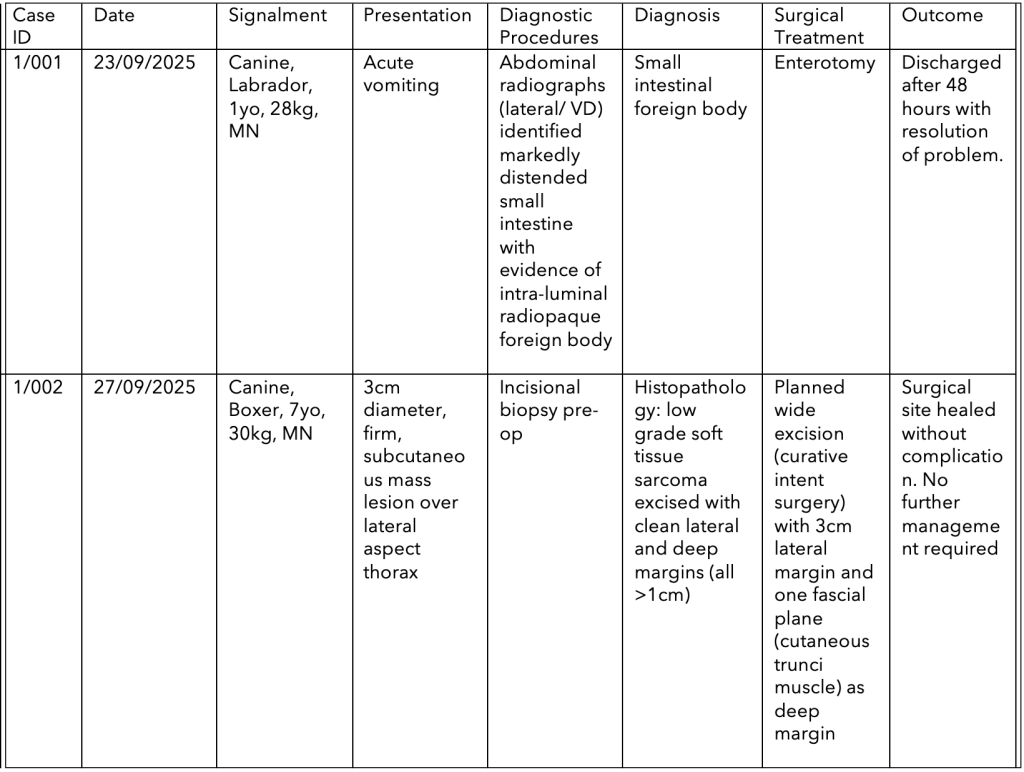
Where appropriate, the log should be supported by useful clinical material such as radiographs, ultrasound images or pre- and post-operative images.
Why do we ask you to keep a case log?
There are two main reasons:
1. It gives your tutors a picture of your clinical experience
Your case log helps your tutors and assessors understand the range of cases you encounter and how you manage them. It is not there as another piece of academic writing to be marked in isolation. It provides context. It gives a useful picture of the breadth of cases you are seeing, how you are managing them, and your outcomes. The Case Log should give a picture of your real clinical work in the subject you are studying.
2. Your cases provide the starting point for reflective learning
The cases in your log will give you material that you can explore more deeply in your critically reflective assignments.
You will not write about every case. Instead, you will select an aspect of a case that connects with the learning outcomes and curriculum for that module.
For example, in the first module of the Small Animal Surgery PgCert, students currently select cases from their log to help them reflect on areas such as theatre practice, surgical biology, perioperative patient management, and core practical techniques. The guidance actually advises students not to try to cover too many cases, because doing so can make the reflection superficial.
A case does not have to be remarkable to be useful. Straightforward cases can often raise issues that are worth reflecting on deeply. It could be a clinical decision that you later questioned, something that went particularly well or a complication that occurred. This is where your everyday clinical work starts to become the basis for postgraduate learning.
It is also why case-based reflective learning can be so powerful in clinical postgraduate education. Rather than learning something academically and hoping that it eventually finds its way into practice, the cycle can be much shorter:
Your case → reflection → deeper reading and analysis → new insight → application to your next cases
Over a 12-month programme, repeating that process can have a substantial effect on the way you think and work as a clinician.
Do all my cases have to be different?
No.
You can include more than one case involving the same diagnosis or procedure. In fact, seeing similar cases repeatedly can be very valuable because it allows you to build experience and compare how your decision-making and management develop.
What matters is that the case log as a whole shows a suitable breadth of experience for that module.
For example, on a soft tissue surgery module, you would not normally want every case in the log to involve abdominal surgery. You would aim to include experience across a reasonable range of the areas covered in the module. Routine neutering should not be included unless there was a specific aspect or event that warranted deeper reflection.
Different modules have slightly different requirements. In the first Small Animal Surgery module, for example, the case log can include a mix of soft-tissue and orthopaedic cases. Later modules require experience in more specific areas because these cases provide the basis for the reflective assessment.
So, the aim is not to find a completely different procedure for every line of the log. It is to build a representative picture of your experience across the subject you are studying.
Do the cases need to be unusual or complicated?
Definitely not.
An unusual case can be interesting, but it does not automatically make it educationally valuable. A relatively straightforward case with a complication may raise an important question about your diagnostic approach, management strategy, or a situation in which contextualised care was a central consideration. By reflecting on and exploring these aspects of the case, you may well develop and implement a new, more effective approach in the future. This is where using your own cases becomes particularly powerful. You examine what you did and why, interrogate the literature and your own experience, and then develop a different or more considered way of approaching a similar case in future.
And, of course, a case that went particularly well can be just as valuable for critical reflection as one that developed a complication.
What if I am worried I will not see enough suitable cases?
If you are unsure whether your caseload will provide the experience you need, speak to us before enrolling or as early as possible during the programme.
Some modules require a broad range of everyday cases, while others require experience of specific procedures or clinical areas. In some circumstances, students arrange additional clinical exposure with another practice or referral centre to gain experience of cases they do not commonly see themselves.
We normally want the case log to reflect cases you are managing during your PgCert learning. However, if you have a relatively recent case from shortly before the programme that provides particularly valuable reflective material, it may sometimes be appropriate to include it. The PgCert team can advise you on this.
In a nutshell
- Your case log should contain a representative range of cases relevant to the module.
- The exact number and type of cases varies between the PgCerts and modules.
- Your cases do not all have to be completely different.
- You do not need rare or unusually complicated cases.
- Everyday clinical cases can provide excellent evidence of your development.
- Some modules require particular types of case, and these will be clearly explained in your programme guidance.
- The case log records the breadth of your clinical experience; selected cases can then be explored in greater depth through reflective work.
- If you are concerned about your likely caseload before starting a PgCert, talk to the CPD Solutions team so we can help you understand the requirements.