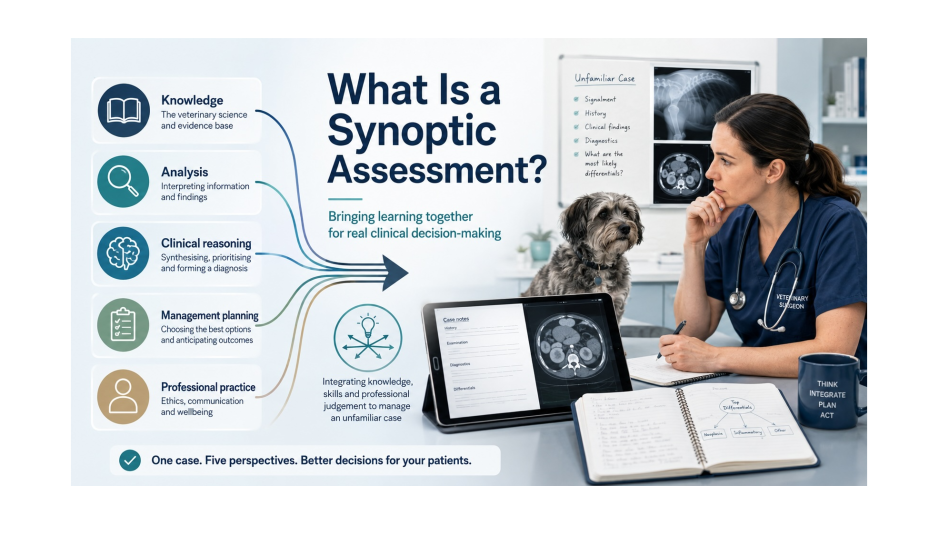
A synoptic assessment asks you to bring together what you have learned across a whole programme and apply it to an unfamiliar case or problem.
In veterinary education, it tests whether you can use knowledge and skills from different parts of the programme together to make safe, reasoned and professionally responsible clinical decisions.
The word synoptic is sometimes used in academic language, but the underlying idea is straightforward: rather than assessing each module in isolation, the assessment looks at how well you can bring things together and integrate your learning.
…..what you have learned across the programme and use it to make safe, reasoned and professionally responsible decisions i
What does “synoptic” mean?
The word synoptic refers to bringing different elements together to form an overall view.
During a PgCert, subjects may be taught and assessed separately, usually grouped together in modules. A surgical programme might include:
- Diagnostic investigation
- Surgical anatomy
- Patient preparation
- Theatre practice and equipment
- Perioperative care
- Managing complications
- Patient welfare
- Professional judgement
In clinical practice, however, these areas rarely remain separate.
When a patient arrives, you must decide:
- which information is most important
- which problems are urgent
- how the different findings relate to one another
- what should happen next
- whether your original plan still makes sense as the case develops
A synoptic assessment examines whether you can make those connections.
The RCVS guidance is clear that it should not function as a final examination of the individual modules. Instead, it should assess whether you can assimilate, integrate and apply the learning gained across the programme.
What might you be asked to do?
In a synoptic assessment you may need to:
- Identify and prioritise the main clinical problems
- Interpret clinical findings in context
- Decide what further information is needed
- Justify diagnostic and treatment choices
- Adapt your reasoning when new information appears
- Develop and sequence an appropriate management plan
- Consider welfare, communication, cost and the limits of your competence and the facilities available
The precise format can vary between postgraduate programmes. What makes the assessment synoptic is its purpose: bringing different areas of learning together and applying them coherently.
Is a synoptic assessment just another exam?
It may take the form of a written examination, an oral assessment, an unfolding case or another structured method.
However, it should not simply ask you to reproduce information.
Knowledge remains essential. You cannot reason effectively about a clinical problem without understanding the relevant anatomy, pathology, diagnostic principles and treatment options.
The difference is that you must use that knowledge.
Instead of being asked to list possible causes of a clinical sign, you might need to:
- identify the most likely possibilities in this particular patient
- decide which problems require immediate action
- select investigations that would genuinely affect your next decision
- interpret the results
- revise your priorities as the situation changes
- formulate and justify a safe management plan
The emphasis is on:
- interpretation rather than description
- prioritisation rather than simple recognition
- justification rather than unsupported assertion
- adaptation rather than a fixed answer
What might a synoptic case look like?
A synoptic case will usually be unfamiliar to the candidate and may unfold in stages.
An unfamiliar case does not mean a deliberately obscure case or one that depends on knowledge outside the programme. It means a case that you have not previously selected, researched or prepared as an assessment response. This allows the assessment to examine how you apply your learning, rather than how well you can reproduce a rehearsed answer.
For example, a case could begin with a dog in severe respiratory distress. The candidate may initially need to recognise the emergency, minimise stress and prioritise stabilisation.
Further information may then reveal:
- an inadequate response to initial treatment
- findings consistent with laryngeal dysfunction
- evidence of aspiration pneumonia
- possible underlying neuromuscular disease
- owner concerns about prognosis and cost
The candidate must continually reconsider the case rather than treating each new finding as a separate question.
Another case might begin with a cat following a road traffic accident. The initial priority may be thoracic stabilisation, but repeated examination and laboratory results may later reveal an evolving urinary tract injury.
The candidate must recognise that the clinical priorities have changed and adjust the diagnostic and treatment plan accordingly.
These examples show why a synoptic assessment is different from answering isolated questions.
The case develops. Information is incomplete. Priorities compete with one another. The candidate must decide not only what to do, but when, why and in what order.
What does a synoptic assessment actually assess?
The RCVS identifies five broad assessment constructs, or areas, that an eligible synoptic assessment should examine. The CPD Solutions Synoptic Pathway assesses candidates across these five areas.
1. Knowledge and integration
Can you draw on relevant knowledge from across the programme and apply it accurately to the case?
This is more than recalling information from one teaching session. It involves recognising which knowledge is relevant and understanding how different clinical principles interact.
For example, a candidate may need to integrate:
- anatomy
- pathophysiology
- diagnostic information
- perioperative management
- surgical options
- complication risks
- professional considerations
The assessment is looking for a connected understanding rather than a collection of isolated facts.
2. Analysis and interpretation
Can you analyse the available information systematically and decide what it means?
This may involve:
- identifying the significant findings
- distinguishing relevant information from incidental detail
- forming a clear clinical problem list
- recognising patterns or inconsistencies
- considering wider contextual factors
- identifying what information is still missing
A strong candidate does not simply repeat the information provided. They organise and interpret it.
3. Clinical reasoning and diagnostic decision-making
Can you develop a coherent and defensible approach to the case?
You may need to:
- formulate differential diagnoses
- prioritise them appropriately
- select suitable investigations
- explain why those investigations are useful
- interpret the findings
- refine the plan as new evidence emerges
It is not enough simply to arrive at a possible diagnosis. The assessment is also interested in how you reached it, whether your reasoning is safe and whether you can change your mind when the evidence changes.
4. Treatment and management planning
Can you develop a safe, appropriate and realistic plan?
This may include:
- prioritising immediate treatment
- explaining the sequence of interventions
- incorporating diagnostic findings into the plan
- considering alternative approaches
- anticipating complications
- adapting to the facilities and expertise available
- deciding whether referral is appropriate
There may be more than one defensible answer.
What matters is whether the plan is clinically sound, proportionate and properly justified.
5. Professional practice
Can you apply appropriate professional judgement?
Clinical decisions do not take place in isolation. Depending on the case, you may need to consider:
- animal welfare
- patient safety
- ethical responsibilities
- communication with the owner
- communication within the clinical team
- biosecurity
- financial and practical constraints
- your own competence and limitations
- in-house management versus referral
- informed consent
A treatment may be technically possible without being the most appropriate choice for that particular patient and owner.
These five areas are closely connected, but they are not interchangeable. A candidate may possess very good factual knowledge but still interpret a situation poorly or propose an unsafe sequence of treatment. The purpose of the assessment is to examine how knowledge, reasoning, management and professional judgement work together.
How is this different from a reflective portfolio?
Reflective portfolios and synoptic assessments have different but complementary purposes.
A reflective portfolio examines your own clinical practice
In a reflective assignment, you may look back at a case you have managed yourself.
You can consider:
- the decisions you made
- the evidence that informed them
- what went well
- what could have been done differently
- what you learned
- how the experience will influence your future practice
This can provide valuable evidence of professional development. It shows whether you are becoming a more thoughtful, evidence-informed and self-aware clinician.
A synoptic assessment asks you to respond to something unfamiliar
In a synoptic assessment, you are presented with a case you have not previously selected, managed or researched.
You do not know the final outcome.
You must interpret the information available at each stage, make a decision and then adapt when further information is released.
The distinction can be summarised as:
- Reflective assessment: What have you learned from your own clinical practice?
- Synoptic assessment: Can you transfer and apply that learning to a new clinical situation?
The two forms of assessment therefore complement one another.
The reflective portfolio examines development through your own cases. The synoptic assessment confirms whether you can integrate and transfer that learning across unfamiliar cases.
A synoptic assessment should therefore be understood principally as an assessment of:
- integrated knowledge
- interpretation
- clinical reasoning
- decision-making
- management planning
- professional judgement
It complements practical training and workplace experience rather than replacing them.
How should I prepare for a synoptic assessment?
Preparing for a synoptic assessment should involve more than memorising additional information.
When reviewing clinical cases, practise asking:
- What are the principal clinical problems?
- Which problem is the most urgent?
- What information is missing?
- Which investigation would meaningfully change my plan?
- Which interventions should happen now?
- Which can safely wait?
- What are the reasonable alternatives?
- What risks are associated with my preferred approach?
- How might new information change my priorities?
- Am I working within my competence and facilities?
- When would referral be appropriate?
- How would I explain the options and uncertainty to the owner?
Try to justify each decision.
A well-reasoned and clinically defensible response is more valuable than an unsupported answer that happens to reach the expected conclusion.
How does the CPD Solutions Synoptic Pathway work?
All students on the CPD Solutions PgCert in Small Animal Surgery complete the same three-module programme. The Synoptic Pathway is an optional additional route for veterinary surgeons who may wish to use their qualification as part of an application for RCVS Advanced Practitioner status.
Students following the Synoptic Pathway complete an additional three-hour synoptic assessment. This uses three unfamiliar clinical cases, with information released in stages. You will be required to interpret the findings, explain and justify your decisions, and reconsider your approach as each case develops.
Each case examines five connected areas: knowledge and integration, analysis and interpretation, clinical reasoning and diagnostic decision-making, treatment and management planning, and professional practice. Candidates must pass all three cases.
You do not have to decide which pathway to follow when you first enrol on the PgCert. However, making the decision earlier gives you more time to understand the assessment requirements and prepare for the synoptic cases alongside your studies.
An additional assessment fee applies to the Synoptic Pathway.
What does this mean for RCVS Advanced Practitioner status?
The CPD Solutions PgCert in Small Animal Surgery with Synoptic Pathway is recognised by the RCVS as an accepted qualification for an application for Advanced Practitioner status.
Successfully completing the pathway does not, however, automatically make someone an RCVS Advanced Practitioner. It means that the qualification can be used as the postgraduate qualification component of an application.
Applicants must also satisfy the wider RCVS requirements, including those relating to professional experience, continuing professional development, professional skills and clinical governance. Applications are considered separately by the RCVS.
The distinction is therefore important:
An approved synoptic pathway may provide an eligible qualification towards an application for Advanced Practitioner status. It does not confer that status by itself.
In a nutshell
- A synoptic assessment brings learning from across a programme together.
- It applies that learning to unfamiliar cases or clinical scenarios.
- It is not simply a final examination of the taught modules.
- It assesses knowledge, interpretation, clinical reasoning, management planning and professional practice.
- Cases may develop in stages, requiring candidates to reconsider their priorities.
- Reflective portfolios and synoptic assessments assess different but complementary abilities.
- A written synoptic assessment does not directly assess physical technical skill.
- An approved synoptic pathway may provide an eligible qualification towards an RCVS Advanced Practitioner application.
- It does not automatically confer Advanced Practitioner status.